
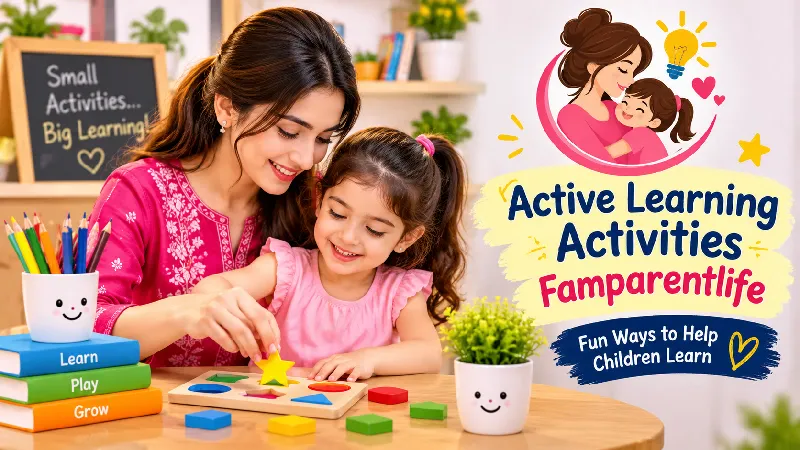
Children learn best when they explore, create, ask questions, and solve problems. Learning doesn’t always happen through books or classroom lessons. Simple activities at home can also help children develop important skills while having fun.
Parents play an important role in making learning enjoyable. By offering children different hands-on experiences, parents can support their creativity, confidence, communication, and problem-solving abilities.
In this guide, we will explore some simple and enjoyable active learning activities famparentlife that parents can try at home. These ideas are easy to follow, affordable, and suitable for different learning needs.
What Is Active Learning and Why Is It Important?
Active learning is a way of learning in which children take part in activities instead of only listening or watching. They learn by touching objects, asking questions, experimenting, building things, and exploring their surroundings.
For example, when a child plants a seed, waters it, and watches it grow, they learn basic science through real experience.
According to the National Association for the Education of Young Children (NAEYC), play-based learning supports children’s language, social, emotional, and thinking skills.
Active learning can help children:
- Develop problem-solving skills.
- Improve memory and concentration.
- Build creativity and imagination.
- Become more confident and independent.
- Improve communication and teamwork.
- Understand new ideas through practical experiences.
7 Best Active Learning Activities for Children at Home
Parents do not need expensive toys or special learning equipment to create meaningful learning experiences. Everyday household items can become useful learning tools.
Here are seven practical ideas to get started.
1. Fun Science Experiments
Science experiments are a great way to develop curiosity. Children enjoy discovering how things work, especially when they can see the results themselves.
Try a simple floating and sinking experiment.
Fill a bowl with water and gather a few safe objects, such as a plastic spoon, a small toy, and a large leaf. Ask your child to guess which objects will float and which will sink.
Then let them test their guesses.
Learning benefits:
- Encourages curiosity.
- Develops observation skills.
- Introduces basic science concepts.
- Helps children understand cause and effect.
Always supervise children during experiments, especially around water and small objects.
2. DIY Art and Craft Projects
Art and craft activities allow children to express their ideas through colors, shapes, and designs.
Give your child paper, crayons, washable colors, and safe craft materials. Ask them to create a picture of their favorite animal, family, or place.
You can also use empty cardboard boxes to make toy houses or simple decorations.
Learning benefits:
- Improves fine motor skills.
- Encourages creative thinking.
- Develops hand-eye coordination.
- Builds confidence through self-expression.
Remember that the goal is to enjoy the creative process, not to make a perfect picture.
3. Cooking and Baking Together
The kitchen can become an interesting learning space for children. Simple cooking activities introduce basic math, science, and everyday life skills.
Ask your child to help wash fruits, mix ingredients, or count vegetables. You can also teach basic measurements using cups and spoons.
For example, ask them to count three apples or measure one cup of flour.
Learning benefits:
- Introduces counting and measurement.
- Improves listening skills.
- Develops independence.
- Teaches healthy food habits.
Choose age-appropriate tasks and keep children away from sharp knives, hot surfaces, and other kitchen hazards.
4. Nature Exploration
Outdoor activities give children an opportunity to learn about the natural world.
Take your child to a garden, park, or safe outdoor area. Encourage them to observe leaves, flowers, birds, and insects.
You can ask simple questions such as:
- What colors can you see?
- Why do plants need water?
- How many different leaves can you find?
These questions encourage children to think and share their observations.
Learning benefits:
- Builds environmental awareness.
- Improves observation skills.
- Encourages physical activity.
- Develops curiosity about nature.
5. Building Blocks and Puzzle Games
Building blocks and puzzles are excellent tools for developing logical thinking.
Give your child blocks and ask them to build a tower, bridge, or small house. If they enjoy puzzles, start with simple designs and gradually introduce more challenging ones.
Allow children to experiment and find their own solutions.
Learning benefits:
- Develops problem-solving abilities.
- Improves concentration.
- Introduces shapes and patterns.
- Encourages patience and persistence.
6. Storytelling and Role-Playing
Storytelling helps children improve their language and communication skills. It also gives them a chance to use their imagination.
Read a short story together and ask your child what might happen next. You can also encourage them to create their own stories.
Role-playing is another enjoyable option. Children can pretend to be teachers, doctors, shopkeepers, or chefs.
Learning benefits:
- Improves vocabulary.
- Builds communication skills.
- Encourages imagination.
- Develops social understanding.
7. Simple Math Games
Math becomes easier when children practice it through everyday activities.
You can turn counting into a fun game by asking your child to count toys, buttons, fruits, or building blocks.
For older children, introduce simple addition and subtraction using everyday objects.
For example, place five blocks on the table and remove two. Ask your child how many blocks are left.
Learning benefits:
- Improves counting skills.
- Builds basic number knowledge.
- Develops logical thinking.
- Makes mathematics enjoyable.
How Parents Can Make Learning More Effective
Choosing good activities matters, but how parents support children also matters.
Follow your child’s interests: Choose activities that match what your child enjoys. Interested children are more likely to stay engaged.
Allow children to make mistakes: Mistakes are a natural part of learning. Give children time to try again instead of giving answers right away.
Ask open-ended questions: Questions like “What do you think will happen?” encourage children to think independently.
Keep activities age-appropriate: Younger children may enjoy simple sensory games, while older children can explore more challenging projects.
Celebrate small achievements: Appreciate your child’s effort, creativity, and progress. This helps build confidence.
According to Harvard’s Center on the Developing Child, playful activities can help children practice important skills such as attention, working memory, and self-control.
How Much Time Should Children Spend on Active Learning?
No single time limit works for every child. It depends on their age, interests, energy, and attention span.
Younger children often benefit from short activities with breaks. Older children may enjoy longer projects that allow them to explore a topic in greater detail.
Instead of forcing children to complete an activity, watch for their interests and adjust the experience accordingly.
A balanced routine should also include outdoor play, rest, family time, and free play.
Final Thoughts
Learning can be an enjoyable part of everyday family life. Parents do not need expensive resources or complicated lesson plans to help children develop important skills.
The active learning activities of the family-parent-life approach encourage parents to make learning practical, creative, and enjoyable through simple experiences at home.
From science experiments and cooking to puzzles and storytelling, every activity can offer a new learning opportunity. Start with small ideas, follow your child’s interests, and give them enough freedom to explore.
Remember, the best learning experiences aren’t always the most complicated. Sometimes, a simple activity shared with a caring parent can make a lasting difference in a child’s learning journey.
FAQs
1. What are active learning activities for children?
Active learning activities are hands-on experiences that help children learn by doing. Examples include science experiments, puzzles, cooking, storytelling, and art projects.
2. How do active learning activities help children?
They support creativity, communication, problem-solving, concentration, and independent thinking. They also make learning more interesting and enjoyable.
3. Can parents do active learning activities at home?
Yes. Parents can use everyday household items, toys, books, and natural materials to create simple learning experiences at home.
4. What is the best age to start active learning?
Children can begin exploring simple learning activities from infancy. Activities should be adjusted according to their age, abilities, interests, and developmental needs.
5. Are active learning activities expensive?
No. Many useful activities cost very little or nothing. Parents can use cardboard boxes, paper, household objects, puzzles, and outdoor materials to encourage learning.
