
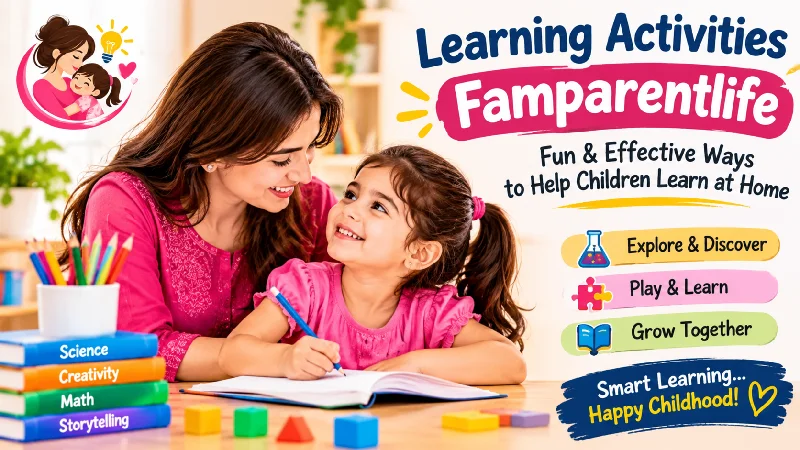
Children learn more effectively when they have opportunities to explore, experiment, create, and discover new things. Learning does not have to be limited to classrooms, textbooks, or homework. Everyday family activities can also become valuable learning experiences when parents make them engaging and enjoyable.
The concept of learning activities famparentlife focuses on making education a natural part of family life. By introducing simple, interactive activities at home, parents can help children develop essential skills, build confidence, and foster a lifelong interest in learning.
In this guide, we explore practical learning ideas, their developmental benefits, and effective ways parents can create a supportive learning environment without spending much money.
Why Are Learning Activities Important for Children’s Development?
Childhood is an important stage for developing intellectual, emotional, social, and physical abilities. Children need opportunities to practice different skills through real-life experiences.
Interactive learning encourages children to participate rather than simply memorize information. It allows them to ask questions, make decisions, solve problems, and understand how things work.
Some important benefits include:
- Better problem-solving skills: Children learn to think independently and find solutions.
- Improved communication: Group activities encourage children to express their thoughts.
- Stronger creativity: Art, storytelling, and imaginative play develop creative thinking.
- Greater confidence: Completing small tasks helps children feel capable and independent.
- Social development: Family activities teach cooperation, patience, and sharing.
Parents who understand these benefits can make everyday experiences more meaningful and educational.
7 Engaging Learning Activities Parents Can Try at Home
You do not need expensive educational toys or complicated lesson plans to support your child’s development. You can create many effective activities using ordinary household materials.
1. Explore Science Through Simple Experiments
Science experiments are an excellent way to introduce children to observation, curiosity, and discovery.
For example, try a floating-and-sinking experiment. Fill a container with water and collect several safe household objects. Ask your child to predict which objects will float and which will sink.
After making predictions, let them test their ideas and discuss the results.
This activity introduces basic scientific concepts while encouraging critical thinking. Always supervise children around water and small objects.
2. Encourage Creativity With Arts and Crafts
Arts and crafts provide children with opportunities to express themselves through colors, shapes, drawings, and creative designs.
Give your child paper, washable paints, crayons, and age-appropriate craft materials. Encourage them to create pictures, greeting cards, paper animals, or simple decorations.
Rather than correcting every detail, allow children to experiment with their own ideas.
These activities can strengthen fine motor skills, hand-eye coordination, imagination, and self-expression.
3. Make Cooking a Family Learning Experience
The kitchen can become an interesting educational environment. Cooking together introduces children to mathematics, basic science, nutrition, and practical life skills.
Ask younger children to count fruits, identify ingredients, or sort vegetables by color. Older children can practice measuring ingredients using cups and spoons.
For example, preparing a simple fruit salad can teach counting, measurements, and healthy eating habits.
Parents should handle sharp utensils, hot surfaces, and other potentially dangerous kitchen tasks.
4. Discover Nature Through Outdoor Activities
Spending time outdoors gives children a chance to explore their surroundings and build environmental awareness.
Take your child to a garden, park, or safe outdoor space. Encourage them to observe plants, leaves, birds, and insects.
Turn the experience into a nature scavenger hunt by asking children to find different leaf shapes, identify colors, or count flowers.
Outdoor exploration also encourages physical movement, curiosity, and observation skills.
5. Improve Thinking Skills With Puzzles and Building Blocks
Puzzles and building blocks offer valuable opportunities to practice logical thinking and problem-solving.
Give children building blocks and challenge them to create a tower, bridge, or small house. Alternatively, introduce puzzles that match their age and abilities.
Let them experiment with different solutions instead of immediately helping.
These activities encourage concentration, patience, spatial awareness, and persistence.
6. Develop Language Skills Through Storytelling
Reading and storytelling can help children build vocabulary, listening skills, communication, and imagination.
Choose an age-appropriate story and read it together. Afterward, ask questions such as, “What was your favorite part?” or “What do you think happens next?”
You can also encourage children to invent their own stories or act out different characters.
This approach makes reading more interactive and helps children develop confidence when expressing their ideas.
7. Turn Everyday Moments Into Math Games
Mathematics becomes easier to understand when children connect numbers with real-life experiences.
Ask younger children to count toys, arrange objects by size, or recognize different shapes. Older children can practice addition and subtraction using everyday household items.
For example, place six apples on a table and ask your child how many will remain if two are removed.
These simple exercises make mathematics practical, enjoyable, and easier to understand.
How to Make Learning More Effective for Every Child
Successful learning depends not only on choosing the right activity but also on creating an environment where children feel comfortable exploring.
Here are some practical parenting strategies:
Follow your child’s interests: Choose activities based on what your child enjoys. Their natural curiosity can make participation easier.
Respect individual learning styles: Every child develops at a different pace. Adjust activities according to their abilities, interests, and developmental stage.
Encourage questions: Instead of providing immediate answers, ask children what they think and encourage them to explain their ideas.
Accept mistakes: Mistakes are part of the learning process. Give children opportunities to try again without discouraging them.
Recognize effort: Appreciate creativity, patience, and improvement rather than focusing only on perfect results.
These approaches make learning more positive and help children become independent thinkers.
READ MORE: Active Learning Activities Famparentlife Fun Ways to Help Children Learn
Creating a Balanced Learning Routine at Home
A consistent routine can help children develop healthy learning habits. However, parents should avoid turning every moment into a formal lesson.
The best parent-led learning activities combine educational experiences with free play, outdoor exploration, family interaction, and enough rest.
You can introduce short activities throughout the week, such as reading before bedtime, counting ingredients during cooking, or exploring nature on weekends.
Pay attention to your child’s energy and interest. Younger children may prefer shorter activities, while older children might enjoy longer creative projects.
Flexibility is important because children learn best when they feel supported rather than pressured.
Final Thoughts
Helping children develop important skills does not require expensive resources, complicated schedules, or professional teaching equipment. Simple experiences at home can create meaningful opportunities for discovery and growth.
By introducing learning activities famparentlife into everyday family routines, parents can encourage creativity, communication, independence, and problem-solving abilities.
Start with one activity, follow your child’s interests, and celebrate their progress along the way. Most importantly, remember that meaningful learning happens when children feel curious, confident, and supported by their families.
FAQs
1. What are the best learning activities for children at home?
Science experiments, arts and crafts, cooking, storytelling, puzzles, nature exploration, and simple mathematics games are excellent options.
2. How can parents make learning enjoyable?
Parents can use interactive games, hands-on experiences, creative projects, and everyday household activities to make learning fun.
3. Are home learning activities expensive?
No. Many activities require only basic household materials, such as paper, cardboard, building blocks, books, and everyday objects.
4. How much time should children spend on learning activities?
There is no universal time limit. Parents should consider their child’s age, attention span, interests, and energy levels while allowing enough time for free play and rest.
5. Why is family involvement important in children’s learning?
Family involvement provides encouragement, emotional support, and opportunities for children to practice communication, cooperation, and independent thinking.
